What is the demographic balancing equation, explained for growing districts
If you work in a national statistics office, you've written this equation on a whiteboard more times than you can count:
P1 = P0 + B − D + I − E
Population at time 1 equals population at time 0, plus births, minus deaths, plus in-migration, minus out-migration. Statisticians call it the demographic balancing equation, or sometimes the population accounting identity, because it has to balance. Every person in your district at the end of the period either was there at the start, was born there, or moved in. Every person who left either died or migrated out. There's no fifth category. If your numbers don't reconcile, you've mismeasured one of the components, not found an exception to the rule.
It's the same logic as a bank statement. Opening balance, plus deposits, minus withdrawals, equals closing balance. Demographers just call the deposits and withdrawals "components of population change."
What each term actually costs you to measure
Births and deaths are usually the easy half. Most countries run civil registration systems, and even where coverage is incomplete, you can model it with reasonable confidence using standard methods and whatever vital registration data exists. The error bars are known and narrow enough to work with.
Migration is where the equation stops being a formula and starts being a research problem. International migration has some paper trail, border crossings, visa records, work permits. Internal migration, someone moving from a rural province into your fastest-growing district, usually has none. No registration event gets triggered when a household rents an apartment in a new subdivision three towns over. That's the term in the births deaths migration formula that statistics offices consistently have the least confidence in, and it's exactly the term that dominates the total for a district experiencing rapid in-migration.
This is the practical problem with inter-censal estimates for growth districts. The balancing equation is mathematically complete. It is not empirically complete, because one of its four inputs is usually a guess dressed up as a number.
Why the equation alone won't save a growing district
A stable, slow-changing district can get away with weak migration data, because net migration is close enough to zero that the error doesn't move the total much. A district that's added three new residential zones since the last census doesn't have that luxury. If net migration is the largest term in your equation and also the one you're least sure of, your P1 inherits that uncertainty whole.
Statistics offices typically patch this with administrative proxies: utility hookups, school enrollment, voter rolls, building permits. These are honest attempts at a hard problem, but they all measure something adjacent to population rather than population itself, and they lag badly in places where construction is outpacing the paperwork that's supposed to track it.
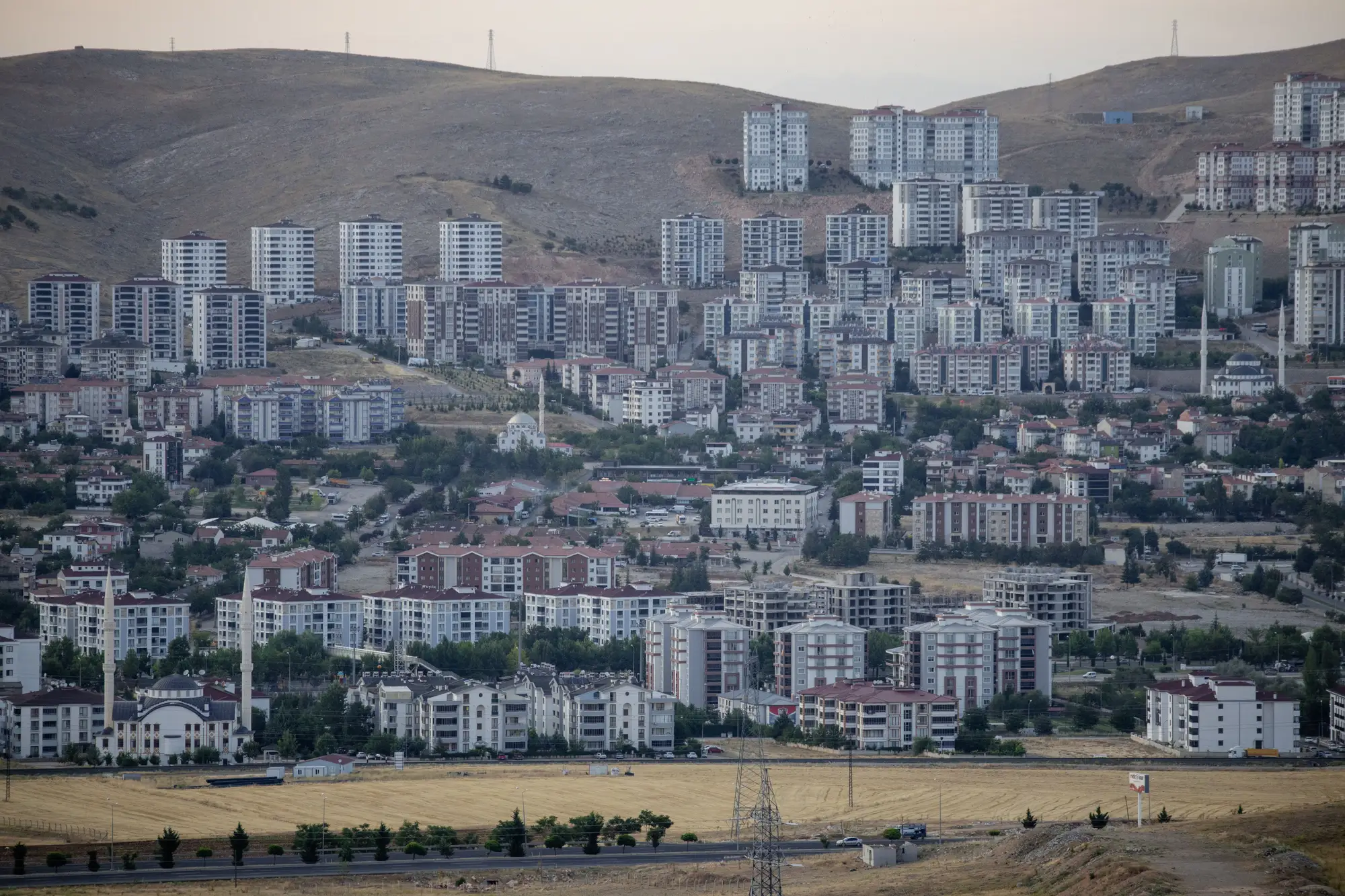
The alternative is to go around the migration term entirely and estimate the stock directly. Count structures, measure built-up area, factor in building height to get a rough occupied-floorspace figure, and you have a population estimate for right now that doesn't depend on reconstructing who moved where since the last census. You still need the balancing equation for your vital events and your official reconciliation, but the stock estimate gives you a number to check it against, or to use on its own when the last census is old enough that nobody trusts the baseline anymore. Population Estimation builds that structure-and-footprint estimate from high-resolution satellite imagery for exactly this gap, an inter-censal year with a district growing faster than the paper trail can follow.
The short version
The demographic balancing equation is the accounting identity behind every population estimate a statistics office produces: start with the last known count, add births and in-migration, subtract deaths and out-migration. It's correct by definition. What it's not is self-verifying. Births and deaths come from registers you can audit. Migration, especially internal migration into a growing district, usually comes from an assumption, and the size of that assumption grows with the size of the district.
If your district is adding housing faster than your migration data can track it, it's worth getting a current population figure from the ground up rather than from the equation alone.